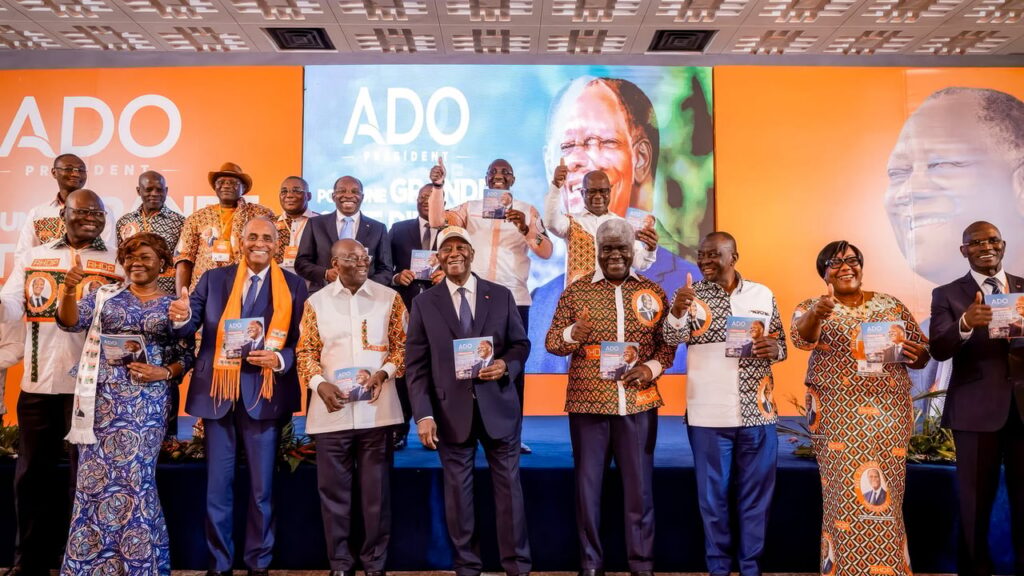
The Rally of Houphouëtists for Democracy and Peace (RHDP) has evolved from a fragile opposition coalition to become the dominant force in Ivory Coast’s political arena. Over two decades, this movement reshaped the country’s governance, consolidating power under a unified banner that traces its roots to the legacy of Félix Houphouët-Boigny.
Initially formed as an alliance between Alassane Ouattara and Henri Konan Bédié to counter Laurent Gbagbo’s influence, the RHDP’s strategic maneuvering transformed it into an electoral juggernaut. What began as a tactical partnership now stands as Ivory Coast’s preeminent political machine, wielding unprecedented influence across the nation’s institutions.
From fragmented opposition to unified dominance
The RHDP’s journey reflects a remarkable political transformation. In its early years, the coalition struggled with internal divisions, mirroring the fractures that had long characterized Ivory Coast’s political landscape. The death of Houphouët-Boigny in 1993 left a power vacuum that exacerbated existing tensions between Ouattara and Bédié, both claiming legitimacy as heirs to the Ivorian Democratic Party’s founding principles.
Yet this rivalry proved temporary. The shared threat posed by Gbagbo’s 2000 electoral victory and subsequent political maneuvers forced the erstwhile adversaries to set aside their differences. Their 2005 alliance, formalized in the Accra Agreements, marked the birth of what would become the RHDP—a coalition designed to unite Houphouët’s political heirs under a single banner.
Strategic consolidation under Ouattara’s leadership
Alassane Ouattara’s ascent to the presidency in 2011 accelerated the RHDP’s evolution into a hegemonic force. His administration systematically dismantled opposition structures while centralizing power within the coalition’s framework. Through strategic alliances with former rivals—including Bédié’s PDCI—and targeted electoral reforms, the RHDP established itself as the country’s dominant political entity.
The coalition’s organizational structure evolved from a loose confederation to a highly disciplined political machine. Regional committees, youth wings, and women’s networks now operate under a unified command structure, enabling the RHDP to mobilize voters with unprecedented efficiency. This organizational transformation has been particularly evident in successive electoral cycles, where the coalition’s dominance has grown increasingly pronounced.
Electoral dominance and institutional control
The RHDP’s political hegemony manifests in multiple dimensions. Electorally, the coalition has maintained consistent victories in presidential, legislative, and municipal contests since 2011. This dominance extends beyond mere vote counts: the RHDP now controls key institutions, including the National Assembly and municipal governments across most of Ivory Coast’s regions.
The coalition’s influence extends to economic policymaking as well. RHDP-aligned technocrats have shaped Ivory Coast’s development agenda, emphasizing infrastructure investment, agricultural modernization, and regional integration. This economic stewardship has further solidified the coalition’s popular support, particularly among urban populations benefiting from improved services and economic opportunities.
Challenges to the RHDP’s unchallenged rule
Despite its dominance, the RHDP faces persistent challenges. Internal dissent occasionally surfaces, particularly regarding succession planning and generational transitions within the leadership. Some political observers note that the coalition’s very success has created vulnerabilities, as its centralized structure becomes increasingly difficult to maintain amid demographic changes and evolving voter expectations.
Opposition forces, though weakened, continue to challenge the RHDP’s narrative. Critics argue that the coalition’s electoral victories often coincide with controversial procedural changes, while proponents maintain that these reforms have strengthened Ivory Coast’s democratic institutions. The delicate balance between political control and democratic legitimacy remains a defining tension in the RHDP’s ongoing evolution.
Future prospects for Ivory Coast’s dominant party
The RHDP’s future trajectory will likely determine Ivory Coast’s political direction for years to come. With President Ouattara’s current term approaching its conclusion, succession questions dominate political discussions. The coalition’s ability to navigate this transition without fracturing its coalition will test its organizational resilience.
Meanwhile, the RHDP’s economic agenda faces scrutiny as Ivory Coast grapples with post-pandemic recovery and global economic shifts. Balancing rapid development with social equity remains a critical challenge, particularly as youth unemployment persists despite economic growth. The coalition’s capacity to address these concerns will shape its long-term legitimacy and popular support.
The RHDP’s transformation from opposition coalition to dominant political force represents one of West Africa’s most significant political developments of the past quarter century. Its ability to maintain unity while adapting to changing circumstances has established a new paradigm for political organization in the region, demonstrating how strategic alliances and organizational discipline can reshape national trajectories.