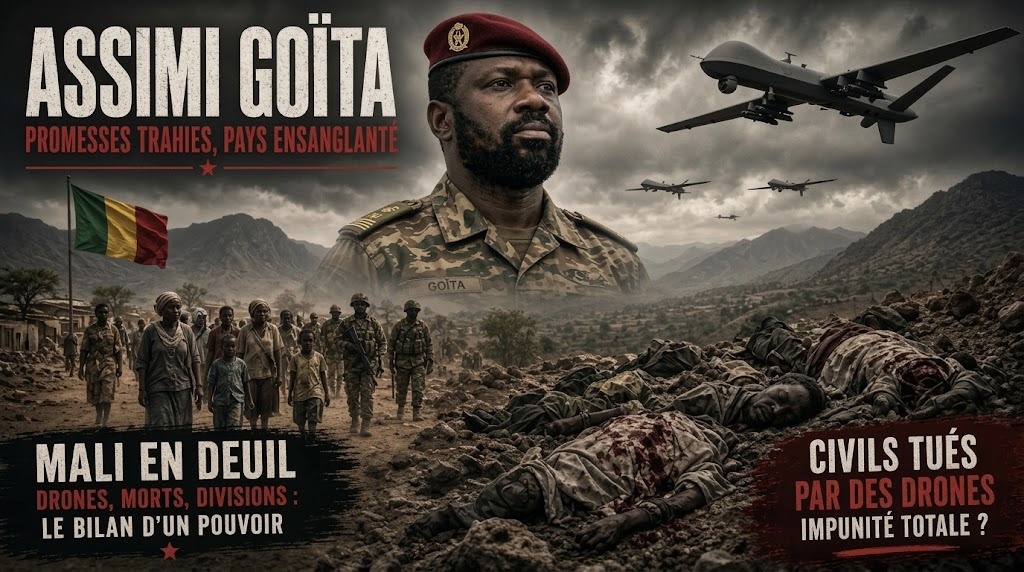
In Mali, the skies have become a battleground not just for armed groups, but for the civilians caught beneath them. What was once marketed as a surgical strike solution—using drones to precisely target militant formations—has evolved into a grim reality where entire villages bear the scars of aerial assaults. New findings reveal a stark turning point: between 2023 and 2026, 199 drone strikes resulted in the deaths of at least 731 civilians, shattering lives and communities across northern and central Mali.
From promises of precision to a crisis of civilian protection
Drones like the Turkish Bayraktar TB2 and Akinci were introduced to the Sahel with promises of enhanced accuracy and reduced collateral damage. Yet, on-the-ground investigations reveal a disturbing pattern: where technology was meant to spare lives, it has often ended them. Families report the sound of a drone’s hum as the prelude to tragedy—a sound now synonymous with fear and loss.
The Malian Armed Forces (FAMa), alongside their partners in the Africa Corps, have expanded their aerial capabilities in response to militant threats. But as the conflict intensifies, so too does the human cost. Investigations into nearly 60 strikes, with 12 independently reconstructed, uncovered evidence pointing to 146 civilian deaths—figures that underscore a systemic failure in distinguishing combatants from civilians.
Children in the crosshairs: a stain on military operations
Among the most harrowing accounts are those involving children. Witness testimonies and digital evidence suggest that in several instances, operators proceeded with strikes despite clear visual confirmation of civilian presence—including minors. One chilling statement from the investigation captures the gravity of these findings: “They saw the children, fired anyway.”
Such actions, if substantiated, violate core principles of international humanitarian law, particularly the requirement to distinguish between combatants and civilians and to take all feasible precautions to avoid civilian harm. Yet the burden of accountability doesn’t rest solely on drone operators. It extends through the entire chain of command—from intelligence gathering and target identification to final strike authorization.
The blurred lines of command: who answers for the dead?
Mali’s aerial campaign involves multiple actors: Malian forces, Russian-linked Africa Corps units, and operators managing Turkish drones. This complex web of responsibility complicates efforts to assign blame. Critical questions remain unanswered: Who identifies a target? Who confirms its military nature? Who validates the strike? And, crucially, who is held accountable when a missile lands on a school instead of a militant hideout?
The opacity of command structures—compounded by shifting alliances and overlapping roles—further obscures the path to justice. For affected families, this ambiguity is a second wound, one that compounds grief with the frustration of impunity.
Technology’s limits: when drones fail to deliver on their promises
Drones are designed to minimize risk to soldiers by keeping them far from the battlefield. Yet, they bring their own set of risks—chief among them, the fallibility of human judgment and flawed intelligence. In regions where armed groups operate amid civilian populations, the margin for error is razor-thin. A shepherd tending livestock, a trader selling goods, or a child playing outside can be mistaken for a threat. The investigation highlights this brutal reality: drones do not discriminate between targets.
A rising toll: the human cost of aerial warfare
Civilian casualties from drone strikes have surged in recent years, marking a dramatic shift from earlier phases of the conflict. While armed groups also perpetrate atrocities against civilians, the expansion of Mali’s aerial arsenal has introduced a new dimension of danger. For local communities, the distinction between a militant’s drone and a government’s strike is irrelevant when both leave families grieving.
The investigation’s findings challenge the narrative of precision warfare. As Sahelian armies adopt increasingly advanced aerial systems, the ethical and legal implications of their use cannot be ignored. A weapon capable of striking from kilometers away does not absolve its operators of the duty to verify their targets.
Beyond the battlefield: the call for accountability
For the hundreds of families who have lost loved ones, the numbers are more than statistics—they are the names and faces of a war that has gone too far. The revelations from this investigation demand a reckoning: one that holds decision-makers responsible, reforms military protocols, and prioritizes the protection of civilians in all operations.
As Mali grapples with the legacy of its drone campaign, one truth remains clear. In modern warfare, distance does not equate to detachment. Those who press the button and those who die beneath it are linked by a chain of responsibility that cannot be broken.