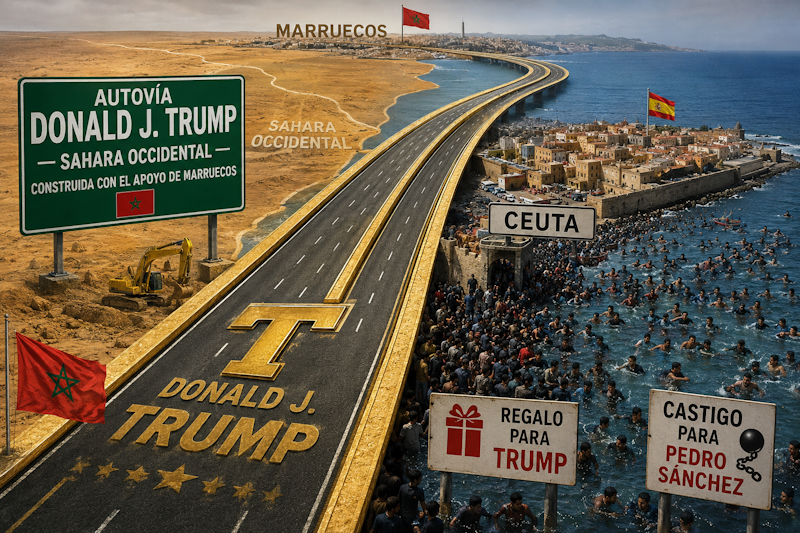
As tensions rise along the Spanish enclave of Ceuta and a symbolic highway in southern Morocco bears the name of Donald Trump, Rabat is deploying a multi-pronged strategy to secure decisive support from Washington on the Western Sahara dispute.
Summer 2026 has become a pivotal moment in Moroccan diplomacy, with Rabat engaging simultaneously with the United States and Spain to advance its claims over Western Sahara—a territory it has administered since Spain’s withdrawal in 1975.
A highway renamed in Trump’s honor
In a bold diplomatic gesture, King Mohammed VI officially designated the Tiznit-Dakhla highway—stretching 1,055 kilometers—as the Donald J. Trump Highway. The move, announced through the official MAP news agency, serves as a formal expression of gratitude for the former U.S. president’s 2020 recognition of Morocco’s sovereignty over Western Sahara.
Described by the monarch as “Africa’s longest road infrastructure”, the highway links southern Morocco to Dakhla, passing through Laâyoune—a key city within the disputed territory. Its strategic importance lies not only in national integration but also in connecting Morocco to Europe.
Trump responded swiftly on Truth Social: “What an incredible honor! I look forward to driving the full length of this magnificent highway—hopefully soon!”
Ceuta: the hidden pressure point
While the highway project captures global attention, Rabat’s most potent bargaining chip remains the volatile border at Ceuta. In late July, nearly 60,000 migrants surged into the Spanish enclave within hours, triggering a humanitarian and diplomatic crisis that left at least 57 people dead, including 11 officially acknowledged by Moroccan authorities.
Ceuta, one of two EU land borders with Africa, has long been a flashpoint in Moroccan-Spanish relations. Rabat does not recognize Spanish sovereignty over the enclave, referring to it as “occupied territory.”
A familiar playbook
This is not the first time Morocco has used migration as leverage. In May 2021, another crisis—this time involving 8,000 entries—forced Spain to shift its stance on Western Sahara, abandoning neutrality to endorse Morocco’s autonomy plan after hosting Polisario leader Brahim Ghali for medical treatment.
“Morocco expected Spain to support its autonomy proposal, but it seeks full recognition of its sovereignty,”
A three-pronged diplomatic offensive
Analysts identify a clear pattern in Rabat’s approach:
- Symbolic diplomacy: The Trump highway renaming reinforces U.S. backing for Morocco’s territorial claims.
- Migration pressure: The Ceuta crisis reminds Spain of its dependence on Moroccan cooperation along the EU’s southern frontier.
- Strategic alignment with Washington: With UN-led negotiations stalled, Rabat prioritizes securing U.S. political support.
Washington’s unwavering stance
The Trump administration has consistently backed Morocco. Secretary of State Marco Rubio reiterated U.S. recognition of Moroccan sovereignty over Western Sahara, while Trump himself praised the autonomy plan as “the only viable path to a fair and lasting solution.”
U.S. officials have also criticized Spain’s migration policies, warning Madrid that its approach “could undermine its own security.”
Europe’s Schengen tensions
The Ceuta crisis has sent shockwaves across the European Union. Italy, Finland, and Denmark suspended parts of the Schengen Agreement with Spain, while Belgian politician Georges-Louis Bouchez called for a partial suspension of Spain’s Schengen membership.
“Morocco has repeatedly demonstrated its willingness to use migration flows as a tool of pressure against Spain, especially given Madrid’s vulnerability along its North African enclaves,”
A calculated message to Madrid and Brussels
Far from being a mere symbolic gesture, the Trump highway and the Ceuta crisis form part of a coordinated strategy: Rabat holds the keys to the EU’s southern border. By combining high-profile diplomatic overtures to Washington and calculated migration pressure on Spain, Morocco is weaving a web of influence designed to strengthen its position in Western Sahara negotiations. European and Spanish negotiators are now keenly aware of the stakes.