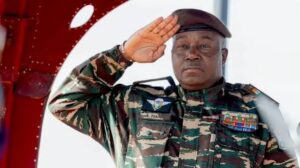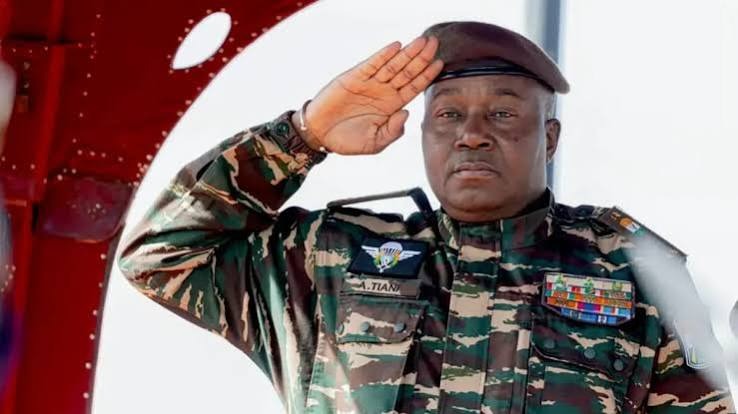
Does General Abdourahamane Tiani ever miss the years when he was simply the man in charge of presidential security — invisible, unburdened and safe? That question now hangs heavy over Niamey’s presidential palace, where the mood has become stifling. A little over three years after the July 2023 coup, the general has been forced to face a truth he never expected: seizing power by force was a colossal miscalculation, and his own life is now the price on the table.
Far from the grand speeches about national sovereignty, the head of the military junta is today a prisoner of the very army he mobilised to take power.
From presidential guard chief to a man under permanent guard
There was a time when Tiani moved freely, precisely because nobody looked at him. As head of presidential security, he stood in the shadows and stayed out of the spotlight. That anonymity is gone. Today he is the most watched man in Niger — and the one doing most of the watching, scanning the ranks around him for the first sign of betrayal.
His fear is no longer something he can hide. Tiani barely leaves his quarters, official trips are quietly cancelled, and he spends his days sealed inside a bunker, shielded by foreign bodyguards and a handful of soldiers he still believes he can count on.
The night at the end of August that redrew every line
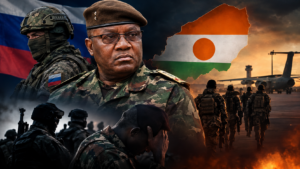
Everything shifted for Tiani during the night of 28 to 29 August 2026. Mutinous soldiers from several garrisons launched an assault on the air base and pushed dangerously close to the presidential palace itself. Only the rapid intervention of Russian mercenaries from Africa Corps pulled him out of the fire. Since that night, the thought of being assassinated has not left him for a single hour.
Storming the air base
The attackers came from more than one barracks, which is what makes the episode so alarming inside the palace walls. This was not the work of a lone, disgruntled unit. It was a coordinated movement with enough strength to reach the gates of the presidency.
A bunker, foreign guards and a shrinking circle of trust
Safety now comes at the cost of freedom. The general’s world has contracted to a few reinforced rooms, a foreign security detail, and the small number of local soldiers whose loyalty he has not yet questioned. Every name outside that circle is a potential threat.
Barmou’s removal: the gamble that boomeranged
Hoping to claw back control, Tiani made a highly risky move in September 2026. He removed General Moussa Salaou Barmou, the chief of staff of the armed forces and one of the central architects of the 2023 coup. Barmou was subsequently placed under house arrest.
The decision did not restore order — it deepened the fracture. Barmou is widely respected and genuinely liked by the elite units, and his removal was read inside the barracks as an act of betrayal rather than a matter of discipline.
Ultimatums delivered from the garrisons
Officers responded with explicit ultimatums to the junta. Their demand: an immediate halt to arrests within the military. Their warning: if the purge continues, they will rise up en masse. What started as an attempt to discipline the army has turned into a standoff between the palace and the men who put Tiani there.
The coup specialist who knows exactly where the danger sits
As a former security professional, Tiani understands the mechanics of a putsch better than most. He knows the playbook because he wrote a version of it himself. And he knows that the gravest threat to his survival no longer comes from terrorist groups along the borders. It comes from the soldiers standing on the other side of his own door.
That is the bitter irony of his position. Toppling a civilian president in 2023 proved straightforward. Governing a country while waiting for one of your own men to fire has turned into a kind of hell.
So the question lingers, unanswered, in the corridors of the palace: when the army is both your shield and your greatest danger, who protects the protector — and what does that uncertainty cost a nation of more than 25 million people?
A general no longer ruling, only surviving
General Tiani is no longer really trying to lead Niger. Ambition has given way to something far more basic. Every decision, every reshuffle, every arrested officer is now weighed against a single measure: does this keep him alive one more day? A power taken by the gun is being held by the narrowest of margins, and the man at its centre knows it better than anyone.