Traditional Leaders in Benin: Pillars of Culture and Governance
In Benin, traditional leaders hold a deeply rooted place in society, blending cultural heritage with institutional recognition. They serve as guardians of local values, traditions, and identities, embodying moral and cultural legitimacy (Affo, Sina, & Gnanvi, 2019). Their roles extend beyond symbolism, as they often mediate conflicts and foster social cohesion, earning them a formal legal framework.
A Legal Framework for Traditional Leadership
To formalize their contributions, the Beninese government enacted Law No. 2025-09 of April 3, 2025, establishing a legal structure for traditional chieftaincies. This reform categorizes traditional leadership and grants them official recognition, emphasizing their role in socioeconomic development, social cohesion, and cultural preservation. Under this law, 16 kingdoms and 90 traditional chieftaincies are now legally recognized (Fatondji, 2025).
Political Involvement and Public Perception
Despite their cultural significance, traditional leaders are often drawn into national politics. Political parties frequently seek their support to sway voter preferences, sometimes offering material benefits or financial incentives in exchange (Cessou, 2017). To curb such practices, Benin has prohibited traditional rulers from engaging in partisan politics (Republic of Benin, 2025).
Citizens’ Trust and Expectations
A recent survey reveals that traditional leaders remain influential in local governance. Nearly a quarter of citizens reported interacting with them in the past year, and a majority expressed trust in their leadership. Many believe their influence should be strengthened. However, concerns about integrity have grown: three-quarters of respondents suspect at least some traditional leaders of corruption, a concern that has intensified since 2022, eroding confidence compared to 2020.
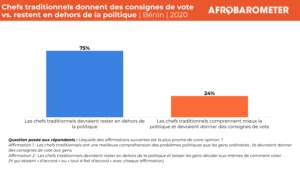
Despite their respected status, most citizens argue that traditional leaders should refrain from political involvement, advocating for voters to make independent choices.
Balancing Tradition and Modern Governance
The evolving role of traditional leaders in Benin reflects a broader tension between cultural heritage and modern governance. While they remain trusted figures, their growing association with political interference risks undermining public confidence. The government’s legal reforms aim to strike a balance, ensuring their contributions to society are preserved without compromising democratic principles.