Three hundred armored vehicles delivered in under a year, in a country that has never run a certified ballistic steel foundry, and an assembly plant that no journalist, auditor or lawmaker has ever been allowed to walk through. That is the claim coming from the very top of Burkina Faso’s transitional government — and it leaves one question hanging over the whole program: how much of the “Nanga” story is industrial reality, and how much is a curtain pulled down over the largest defense purchase in the country’s recent history?
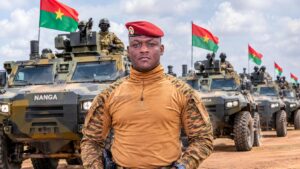
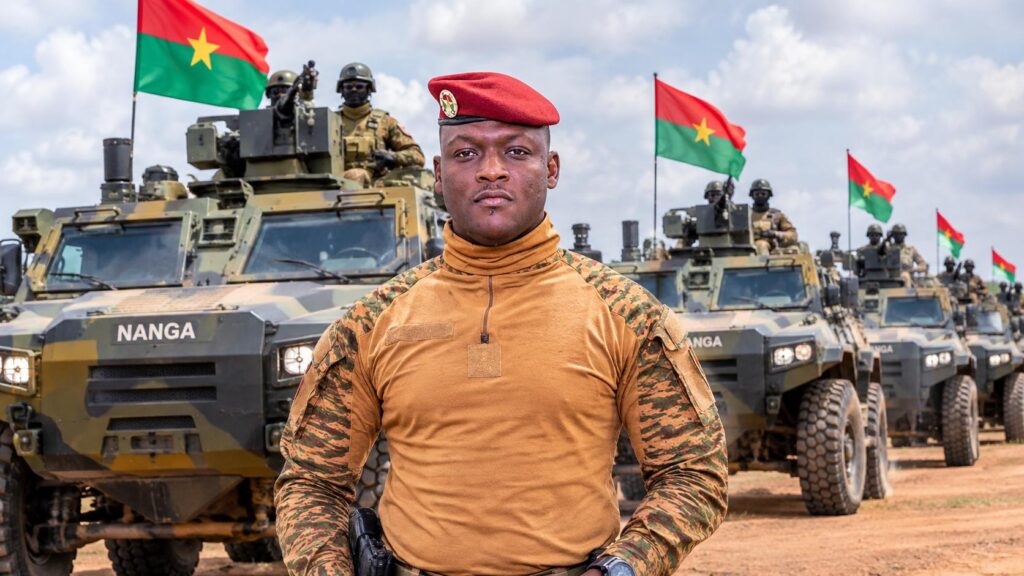
President of the Transition Captain Ibrahim Traoré has stated it plainly: roughly 300 armored vehicles, named “Nanga” after the scorpion, have been produced or adapted locally since November 2025 by Faso Armored, the state-linked company now presented as the backbone of Burkinabè military autonomy. The problem is not the ambition. It is the absence of anything visible behind it. The plant has never been shown, the assembly lines are deemed strictly confidential, and a broad “defense secrecy” rule is invoked whenever verification is requested.
Military experts, civil society figures and observers of the region’s arms trade are now asking the uncomfortable question out loud: could this combination of an invisible factory and an all-purpose secrecy clause be a political screen, designed to hide inflated invoicing and the repackaging of ordinary civilian imports as homegrown hardware?
A miracle nobody has seen, and why the stakes are so high
Armored vehicle manufacturing is not a matter of welding steel plates onto a pickup truck. It requires specialized foundries, certified ballistic steels, reinforced drivetrains, testing grounds and heavy precision engineering — an industrial ecosystem that takes years to build and constant investment to maintain.
If the Nanga program were genuine, it would be a decisive leap for a country fighting an insurgency on several fronts. That is precisely why the credibility of the claim matters so much: it shapes budgets, procurement choices and, ultimately, the survival odds of the soldiers and Volunteers for the Defense of the Homeland (VDP) sent into combat zones.
Is “assembled in Burkina Faso” simply a repackaged import?
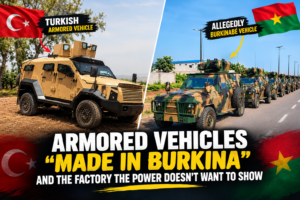
Analysts who follow the regional equipment market describe a familiar pattern. The vehicles badged “Nanga” appear to be ordinary commercial utility platforms — mainly modified Toyota chassis — purchased at low cost from third countries and then fitted with improvised protection in artisanal workshops.
Cosmetic hardening sold as heavy industry
Under this reading, the “Made in Burkina” label would rest on quick cosmetic reinforcement rather than on any real production chain: add-on plating, repainted hulls and new badges. Nothing resembling the metallurgical work, quality control or homologation process that genuine armored vehicle assembly demands.
Ten months, 300 vehicles: a timeline that defies physics
Announcing 300 armored units in less than a year, with no pre-existing industrial base, stretches technical credibility far beyond its limit. Arms manufacturers with automated plants and decades of experience need years to roll out comparable volumes. A country building its first assembly line is not going to compress that into a single budget cycle — and the question of where the vehicles actually came from remains unanswered.
Why the defense secrecy label blocks every budget question
If Faso Armored had genuinely achieved such a feat, the regime would have every reason to show it off. A supervised, even partial, tour for the press would have been a propaganda victory of enormous value. Instead, complete darkness surrounds the site. The secrecy argument is being used, in practice, to do three things:
- Shut down budget oversight: tens of billions of CFA francs are committed to military equipment orders without a public tender process or any review by the Court of Accounts.
- Conceal the true origin and price of materials: hiding the chain of intermediary suppliers also hides the exorbitant commissions collected along the way by well-connected brokers.
- Escape ballistic certification audits: no certified resistance testing — STANAG standards against mines or improvised explosive devices — has been made public, which directly exposes the lives of VDP fighters and frontline soldiers travelling in vehicles of uncertain protection.
When press releases have to stand in for the battlefield
The Nanga announcement landed in a tense political climate where symbolic victories are needed to sustain public support. After the high-profile inauguration of military textile complexes such as TEXFORCES-BF, the narrative of “total independence” called for a spectacular breakthrough in heavy weaponry.
On the ground, the arithmetic does not add up. Security conditions keep deteriorating across several regions, and a steady stream of announcements about “revolutionary” equipment does not close the deep strategic and logistical gaps facing the armed forces. The question, then, is not whether Burkina Faso needs armored vehicles — it clearly does — but whether it is actually receiving them.
The bill Burkina Faso may end up paying
By turning financial and industrial opacity into a method of governance under the seal of defense secrecy, the authorities are drifting into dangerous territory. Between large-scale mechanical improvisation presented as a national industry and a self-proclaimed sovereignty that cannot be inspected, the cost — budgetary, strategic and human — could fall heavily on the Burkinabè people. The stakes are simple: a nation at war cannot afford to buy a story instead of protection.