The patriotic immersion program that sparked serious allegations
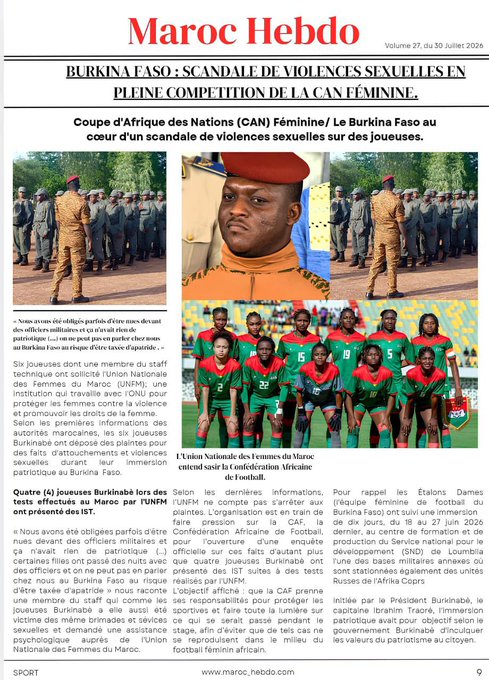
What was touted as a nation-building initiative for Burkina Faso’s female football team has instead become a source of grave concern. Players and technical staff members claim they endured sexual violence during a so-called patriotic immersion stage held at a military camp. According to a complaint filed in Morocco, six athletes and one staff member allege they were subjected to abuses by military officers, raising troubling questions about the boundaries between military authority and civilian protection in the current political climate.
The program, designed to instill discipline, national commitment, and sacrifice ahead of a continental competition, now stands accused of facilitating serious violations. If substantiated, these claims would represent a severe breach of fundamental rights and a stark departure from the principles the regime claims to uphold.
A society increasingly under military influence
The controversy extends far beyond the realm of sports. Since taking power, Captain Ibrahim Traoré has systematically expanded the military’s role beyond traditional defense functions. Military institutions now oversee areas such as civic education, youth programs, cultural initiatives, political communication, and even athletic training.
This sweeping militarization reflects a deliberate strategy to position the armed forces as the primary architects of national renewal. Yet, when civilian institutions are sidelined in favor of military structures in domains outside their original mandate, the safeguards of accountability, oversight, and transparency inevitably weaken. Human rights advocates have repeatedly warned that such a shift erodes democratic checks and balances, leaving citizens more vulnerable to abuse.
Impunity thrives in the absence of accountability
A functioning democracy depends on the balance between institutions. When courts, independent media, civil society organizations, and political parties face shrinking operational space, the ability to expose wrongdoing diminishes significantly. Victims of abuse often hesitate to come forward, fearing professional retaliation, social ostracization, or even physical harm.
The current allegations underscore this dilemma. Reports indicate that the complainants only pursued their claims after leaving Burkina Faso, raising serious doubts about the reliability of domestic mechanisms for justice and protection. The delay in reporting suggests a profound lack of trust in local institutions capable of addressing such grave violations impartially.
The silencing effect of a repressive climate
Several factors contribute to the stifling of dissent in today’s Burkina Faso. Criticism of military authorities is frequently equated with disloyalty or even tacit support for armed groups. Journalists, activists, and civil society leaders face intimidation, coercive measures, or worse for speaking out. Media restrictions further constrain independent investigation, while a security-first agenda marginalizes human rights concerns and victim protection.
This environment does not necessarily reflect societal approval of state actions. More often, it reflects fear—fear of reprisal, fear of being labeled a traitor, and fear that speaking out will only invite further harm. In such a climate, silence cannot be mistaken for consent.
An issue that transcends the world of sport
This incident is not merely about football or a single training program. It raises critical questions about the role of the military in a society at war and the boundaries governing its involvement in civilian life. It also challenges the state’s ability to ensure the safety of its own citizens when they participate in state-sponsored activities.
Above all, it serves as a reminder that counterterrorism efforts, no matter how justified, cannot justify the permanent erosion of judicial guarantees, public freedoms, or mechanisms of accountability. The rule of law must remain the foundation of any legitimate governance, regardless of the challenges a nation faces.
International intervention: a symptom of institutional failure
The decision to file a complaint with an external organization rather than within Burkina Faso signals a deep crisis of confidence in domestic institutions. For victims, seeking justice abroad represents an attempt to secure impartiality and a fair hearing—something they evidently do not believe can be guaranteed at home.
While the outcome of any investigation remains uncertain, this internationalization of the case could exert significant pressure on Burkinabè authorities to conduct a credible, transparent, and independent inquiry. Accountability, if pursued, would not only address the immediate allegations but also restore some faith in the country’s commitment to justice and human rights.
Conclusion: governance at a crossroads
The allegations surrounding the patriotic immersion program serve as a stark reminder: no political project, no matter how ambitious, can endure without a foundation in the rule of law. Patriotism cannot serve as a shield to obscure accountability or obstruct the pursuit of truth when grave human rights violations are alleged.
Should these claims be substantiated, the case could mark a turning point in the assessment of Burkina Faso’s governance. It would lay bare the dangers of unchecked power concentration and the weakening of institutions meant to protect the citizenry. The path forward demands not only justice for the victims but a recommitment to democratic principles and the restoration of balance between security imperatives and fundamental freedoms.