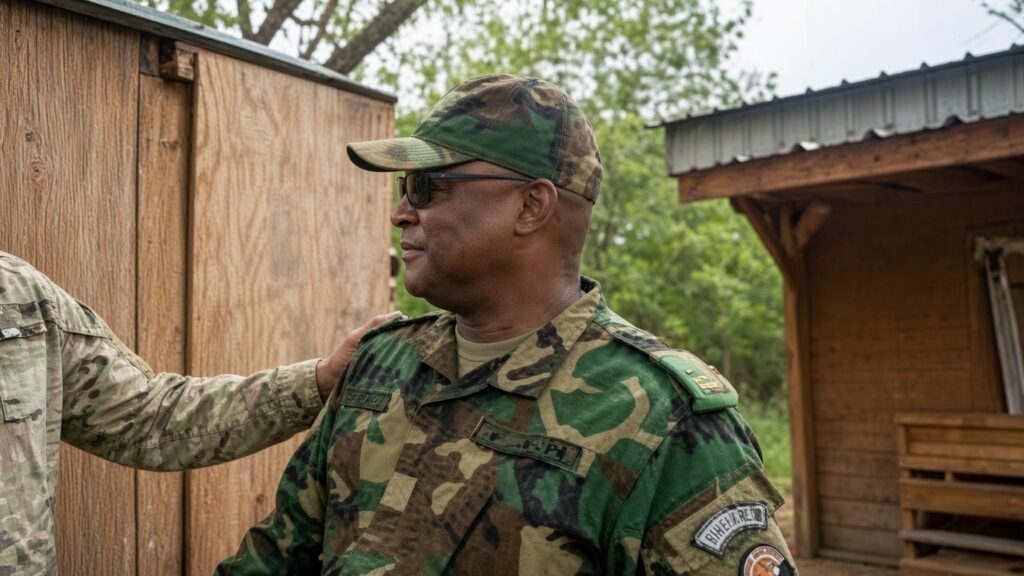
The July 2023 events in Niamey marked a turning point for Niger’s military leadership—but behind the headlines stood an officer whose operational expertise was forged far from the Sahel. General Moussa Salaou Barmou, now Chief of the Armed Forces, spent years mastering advanced warfare techniques in the United States, bringing back a doctrine that has since redefined how Niger’s special forces operate against extremist threats.
From American classrooms to Sahelian battlefields: the making of a special forces architect
General Barmou’s professional journey reads like a masterclass in military excellence. His time at two of the U.S. military’s most rigorous institutions laid the foundation for what would become a transformation of Niger’s elite units.
A rigorous education in asymmetric warfare
At Fort Moore in Georgia—home to the U.S. Army Infantry School—he honed his skills in close-quarters combat, rapid assault tactics, and small-unit leadership. The demanding curriculum taught him how to operate effectively under extreme pressure, a lesson he would later apply in some of the Sahel’s most volatile regions.
At the National Defense University in Washington, D.C., he earned a degree from the College of International Security Affairs, specializing in strategic planning and counterterrorism. This academic grounding gave him the analytical tools to anticipate threats and design long-term security strategies—skills now central to Niger’s defense policy.
Adopting the American playbook for Niger’s elite
Upon returning home, Barmou didn’t just absorb American doctrine—he implemented it. As commander of the Nigerien Special Forces (PFS), he structured the unit along the lines of the U.S. Special Operations Command (USSOC), emphasizing:
- Elite recruitment: stringent selection processes to ensure only the most capable soldiers joined the ranks
- Speed and mobility: rapid-response teams capable of reaching conflict zones in hours, not days
- Intelligence-driven operations: integration of real-time surveillance data to outmaneuver insurgent groups
Real-world impact: turning strategy into decisive action
Barmou’s leadership has reshaped Niger’s counterterrorism approach, turning specialized training into tangible results. His forces have delivered measurable success in two critical theaters:
Rolling back Boko Haram in the Lake Chad Basin
The PFS, restructured under his command, has led targeted strikes against Boko Haram cells, dismantling supply routes and disrupting command structures. These operations have been conducted in close coordination with U.S. forces stationed at Agadez’s Base 201, where joint training exercises simulate real-world scenarios.
Securing the tri-border area against ISIS-affiliated groups
In the volatile region where Niger, Mali, and Burkina Faso meet, Barmou’s forces have implemented a mobile counterinsurgency strategy. Small, highly trained units conduct frequent patrols, gather actionable intelligence, and strike with precision—denying extremist groups the safe havens they once exploited.
More than a soldier: a bridge between Washington and Niamey
Barmou’s deep understanding of American military culture has made him an indispensable link between Niger’s leadership and U.S. defense officials. During critical post-coup negotiations in 2023, his fluency in both operational and diplomatic language ensured that military-to-military channels remained open despite political turbulence. This credibility has allowed Niger to maintain strategic partnerships while navigating internal transitions.
A lasting legacy: modernizing Niger’s defense for an era of hybrid threats
As Chief of the Armed Forces, Barmou has overseen a sweeping reorganization of Niger’s military command, aligning it with the priorities of the Alliance of Sahel States (AES). His vision extends beyond immediate counterterrorism efforts—it’s about building a defense institution capable of adapting to the evolving tactics of 21st-century insurgencies. The result? A force that moves faster, thinks smarter, and strikes harder than ever before.
Key takeaways from Barmou’s transformation
- Special forces restructured along U.S. Special Operations Command models
- Increased operational tempo with rapid-deployment units
- Deeper integration of intelligence and mobility in counterterrorism strategy
- Sustained U.S.-Niger military cooperation despite political shifts
- New command structure aligned with Sahel-wide defense initiatives