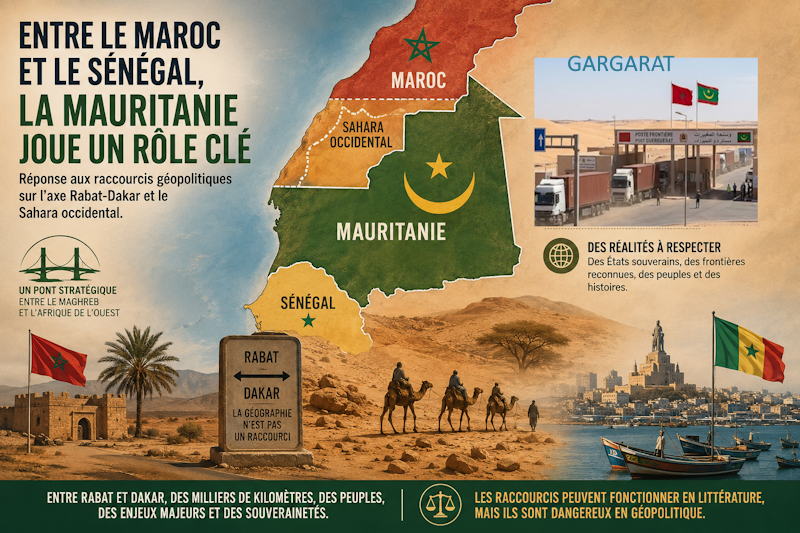

An unexpected diplomatic flare-up in Dakar last July exposed the intricate balancing act Mauritania performs on the Western Sahara issue. Between claims of “positive neutrality,” economic imperatives, and the preservation of its sovereignty, Nouakchott’s carefully crafted ambiguity has become its trademark strategy—especially when it comes to not provoking Morocco.
What began as a routine book launch event at the Moroccan embassy in Dakar quickly escalated into a heated confrontation. Former Senegalese Foreign Minister Cheikh Tidiane Gadio sparked outrage when he remarked that, in Senegalese collective memory, Morocco was located “just a few kilometers away”—a veiled reference to pre-colonial borders that blatantly overlooked Mauritania’s existence. The Mauritanian representative, Mohamed Ould Abdellahi Ould Ethmane, cut the speech short, accusing Gadio of historical revisionism aimed at erasing Mauritania from the map.
While the Moroccan ambassador, Hassan Naciri, swiftly stepped in to calm tensions, the incident laid bare the tightrope Mauritania walks. It must justify its presence at an event glorifying Morocco’s claim over Western Sahara while maintaining a strict neutrality in a conflict now entering its sixth decade.
The fallout from Gadio’s remarks reverberated across Mauritania, with former Foreign Minister Isselmou Ahmed Izidbih taking the unusual step of calling for the Senegalese diplomat to be declared persona non grata. In a public statement, Izidbih declared, “As a Mauritanian citizen, I urge that Cheikh Tidiane Gadio be declared unwelcome in Mauritania’s territorial waters, airspace, and on its soil.”
Nouakchott’s diplomatic tightrope
This incident in Dakar encapsulates the contradictions inherent in Mauritania’s official stance. On one hand, Mauritania has recognized the Sahrawi Arab Democratic Republic (SADR) since 1984, maintains regular communication channels with the Polisario Front, and carefully avoids alienating Algeria—a key ally for its northern border security.
On the other hand, Nouakchott stops short of granting full embassy status to the Sahrawi representation in its capital. This concession to Rabat is deliberate: Morocco views any formal recognition of the SADR as a declaration of war. By attending official Moroccan ceremonies, Mauritania signals respect to its northern neighbor—while ensuring Rabat does not revive, even indirectly, the long-disputed concept of a “Greater Morocco” that once included Mauritanian territory.
The economic lifeline at Guerguerat
Beyond symbolic gestures, Mauritania’s foreign policy is driven by hard economic realities. The Guerguerat border crossing, straddling Western Sahara and Mauritanian soil, has become the vital artery linking Morocco to West Africa.
Daily, hundreds of Moroccan trucks pass through this zone, delivering agricultural and manufactured goods to markets in Mauritania, Senegal, and Mali. For Nouakchott, blocking this trade would be a self-inflicted wound. Securing and opening its borders to this commerce tacitly validates Morocco’s operational control over the disputed territory—without ever acknowledging it legally.
A necessary ambiguity for survival
To regional analysts, Mauritania’s “both-and” approach is not indecision—it is a survival strategy. Trapped geographically between Morocco’s economic ambitions and Algeria’s rigid geopolitical stance, Mauritania cannot afford to pick a side without risking economic retaliation or border instability.
The clash triggered by Cheikh Tidiane Gadio serves as a reminder that this neutrality, no matter how precarious, remains highly volatile. Whenever Mauritania’s national identity or territorial integrity appears threatened by its neighbors’ ambitions, Nouakchott swiftly abandons its usual restraint. The message is clear: it remains the indispensable—and sovereign—pillar of balance in the Maghreb.