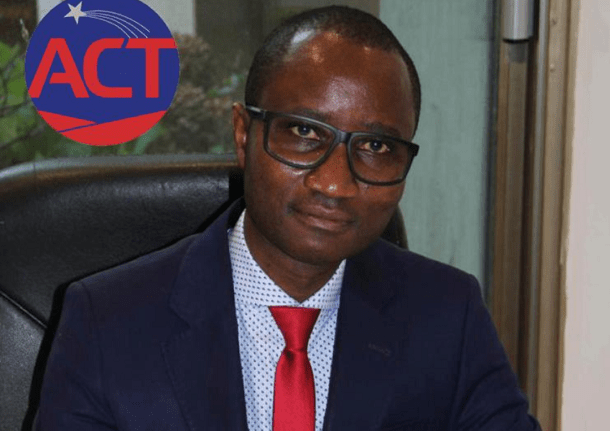
The leader of Senegal’s ACT party, Ibrahima Thiam, has sharply rebuked recent statements made by Ousmane Sonko, describing them as a threat to national unity.
In an opinion piece titled “The Dangers of Generalization in Political Discourse”, Thiam argues that Sonko’s remarks were not only unfounded but also deliberately provocative, stirring controversy around Touba and the Mouride community.
Thiam contends that these statements were not part of a substantive debate but rather a calculated strategy to polarize public opinion through shocking rhetoric. He emphasizes that attributing collective responsibility to an entire city or religious group—especially in a case involving allegations of concealment—constitutes a serious political misstep.
The ACT leader underscores that in a democracy, accountability must be individual, not collective. He warns that when political figures imply guilt by association rather than addressing facts, they undermine national cohesion rather than fostering constructive dialogue.
Thiam further accuses Sonko of employing populist tactics, where sensationalism replaces reasoned argument and media spectacle overshadows policy debate. According to him, this approach is designed to energize Sonko’s political base by fostering an atmosphere of confrontation rather than constructive engagement.
He highlights the significance of Touba—not just as a city but as a spiritual, economic, and historical landmark in Senegal. The Mouride community, he notes, plays a vital role in the nation’s unity, making any public rhetoric that could be interpreted as a blanket indictment of its members particularly reckless.
In closing, Thiam calls for more measured political discourse, urging leaders to ground their statements in facts and mutual respect. His appeal underscores the need to prioritize national unity over divisive rhetoric, ensuring that democratic debate remains constructive and inclusive.