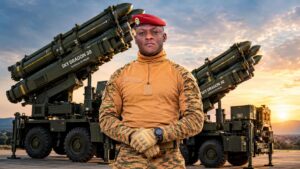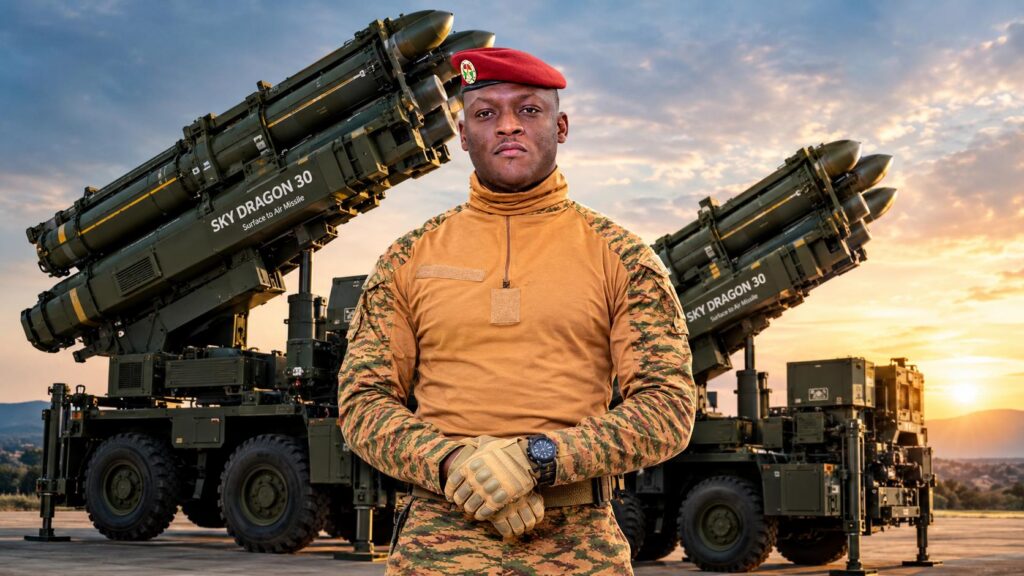
Cameras rolling, armoured vehicles gleaming, triumphant music swelling in the background: the communication machine of Burkina Faso’s transitional government knew precisely how it wanted the unveiling of its latest military trophy to look. Yet the question worth asking is not how imposing the Chinese-made Sky Dragon 30 looks on screen. It is what, exactly, this air-defence system is meant to protect — and who ends up footing the bill when the answer turns out to be no one. In a country where entire villages empty out under the onslaught of gunmen riding motorcycles, pouring millions into intercepting targets up in the clouds is a political sleight of hand whose costs land squarely on the population.
What the Sky Dragon 30 was engineered to bring down
The system, produced by the Chinese state conglomerate NORINCO and designated DK-10A, has nothing whatsoever to do with counter-insurgency work. A quick look at its technical profile is enough to expose how far it sits from Burkina Faso’s reality:
- Its only intended prey: this is a medium-range surface-to-air missile system, built exclusively to lock onto and destroy conventional aircraft — fighter-bombers, attack helicopters, large combat drones and cruise missiles.
- Its reach: radar-guided missiles capable of bringing down targets flying at altitudes of up to 18,000 metres and within a 30-kilometre radius.
- Its radar backbone: a 3D search-and-track radar, the IBIS 80, able to spot aircraft at distances beyond 130 kilometres.
Faced with that much high-end hardware, one blunt question imposes itself: which aerial threat is the military leadership trying to neutralise?
The adversary in Burkina Faso does not fly
The armed terrorist groups bleeding the country dry — the ones laying siege to towns such as Djibo or pushing the inhabitants of Boussouma into exile — own no planes, no helicopters and no cruise missiles. What threatens rural communities is strictly ground-level, mobile and asymmetric: fighters moving in long columns of motorcycles, lying in wait in the bush, planting improvised explosive devices along dirt tracks, or slipping into villages after nightfall.
A Sky Dragon 30 is utterly incapable of spotting, tracking or halting three men on a motorbike hidden beneath the vegetation of the Sahel. Deploying an aerial interception radar against a purely land-based threat makes about as much sense as trying to stop a swarm of wasps with a whaling net.
Staging power to disguise what is happening on the ground
If the equipment is militarily useless against the country’s actual security emergency, why was it purchased? The answer lies in the transitional government’s communication strategy. To keep alive the illusion of recovered sovereignty and to paper over the state’s steady territorial retreat, the military leadership needs large, photogenic symbols.
A surface-to-air missile mounted on an armoured truck produces magnificent footage for national television and social media. It feeds the myth of an army modernising at great expense, and encourages the public to believe that an invisible enemy from outside is lurking over the country — a narrative that justifies security paranoia and the narrowing of political debate.
The stakes: a costly answer to a question nobody asked
While millions of dollars leave the public treasury to pay for Chinese technological toys that cannot be fired at a single terrorist, soldiers on the front line go without basic mine-clearance equipment, without contact intelligence, and without the fuel needed to secure road corridors.
Buying the Sky Dragon 30 is not a military victory. It is an admission of strategic blindness, and a costly propaganda exercise for which the people of Burkina Faso are paying a very high price.