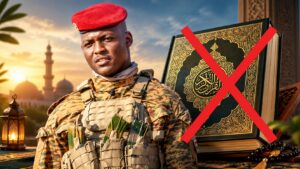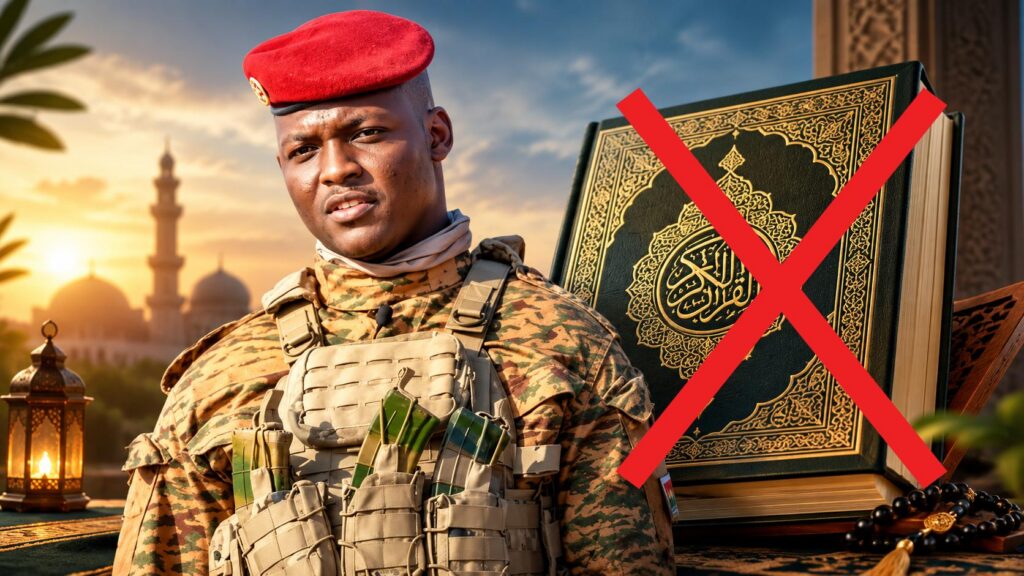
In Burkina Faso, the boundary between fighting armed extremism and suppressing religious freedom has rarely been so blurred. The dilemma the country now faces is as uncomfortable as it is unavoidable: can a government claim to be protecting its people while silencing the Muslim clerics who help hold that same people together? Since the transitional administration led by Captain Ibrahim Traoré began tightening its grip on religious life, a Muslim-majority nation has watched its imams, preachers and Islamic associations come under a level of pressure it had never known before.
Counterterrorism as a justification: where does the logic stop?
For months, the vocabulary of security has served as a ready-made excuse for hunting down independent religious voices. The stated mission is to uproot the terrorist threat bleeding the country dry. The practical result is a system of control imposed from Ouagadougou over the figures and institutions of Burkinabè Islam, wrapped in official talk of “national security”.
Moderate imams, influential preachers and leaders of Muslim associations have found themselves in the crosshairs. Their offence, in most cases, was simply to speak: questioning the methods of the transitional authorities, asking how the security crisis is being managed, or calling for civil rights to be preserved.
Arrests, opaque detentions and forced enlistment
The measures described by families and communities follow a recurring pattern:
- Arbitrary arrests targeting moderate imams and well-known preachers.
- Detention kept out of sight, with relatives left without clear information.
- Forced incorporation into the Volunteers for the Defense of the Homeland (VDP).
- Sustained pressure on Islamic associations, whose officials are questioned, sidelined or pushed aside.
Taken together, these practices have turned religious visibility into a liability for anyone unwilling to align with the official line.
What is happening to mosques and Quranic schools?
Places of worship and Quranic schools in areas facing the heaviest security challenges are now subjected to drastic inspections, administrative closures decided without appeal, and sweeping accusations of collusion with armed groups. When any religious message that is not aligned with the state is labelled “subversive” or treated as complicity with the enemy, the effect is a climate of fear inside a community long recognised for its role in mediation and social cohesion.
Why targeting imams weakens the fight against jihadism
This iron-fisted policy pursues a clear objective: neutralising any social force capable of articulating structured dissent against military rule. By focusing on the networks and leading figures of local Islam, the transitional government is trying to impose a single way of thinking and to lock down public debate.
What it does not do is weaken the jihadist groups operating across the region. Instead, the offensive against religious practice threatens to produce the opposite of what it promises. Stigmatising an entire faith community, dismantling customary and spiritual intermediaries, and depriving worshippers of moderate reference points fuels a deep sense of injustice and alienation.
The price of treating faith as an internal enemy
By turning religion into an enemy within, all in the name of sovereignty and security, Ibrahim Traoré is taking a major risk: atomising the social fabric of a country already pushed to its limits.
The real stake: a cohesive nation or a fractured one?
The question is not whether a state may investigate individuals suspected of violence — it is whether a war against insurgents can be won by turning against the country’s own religious institutions. On that answer hangs the cohesion of Burkina Faso, and the trust between a government and the majority community it governs.