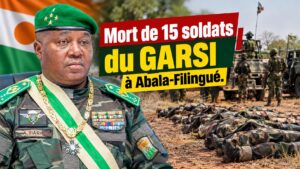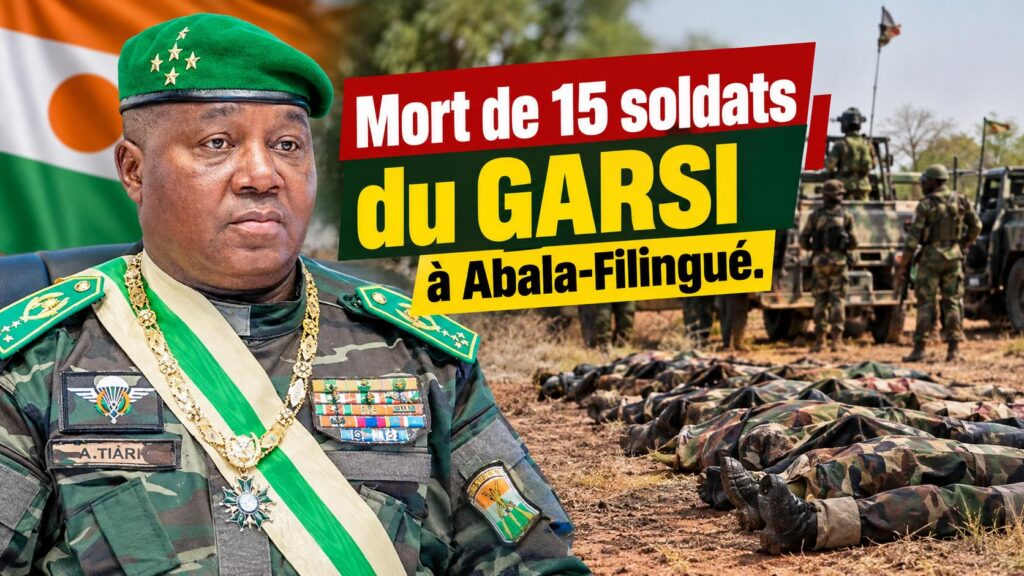
Gunfire broke the silence at dawn in the Abala-Filingué department, and when it faded, an entire patrol of the Rapid Action Group for Surveillance and Intervention (GARSI) had been torn apart. Around fifteen soldiers fell where they stood, including Captain Hassoumie and Adjutant Djindagarey — two names added to a list that refuses to stop growing.
This was no isolated misfortune in a remote corner of the Tillabéri region. It is the sharpest illustration yet of a nation sliding deeper into disorder, and it forces one uncomfortable question: in a country that has placed security at the heart of its own legitimacy, why do the soldiers sent to hold the line keep dying without the means to survive?
The ambush at Abala-Filingué: what the first hours revealed
The violence unleashed on that patrol was of a rare intensity. A unit trained for exactly this kind of confrontation — mobile, hardened, meant to strike fast — was caught and overwhelmed in the field. That the attackers could target such a force at all says as much about their confidence as it does about the vulnerability of those sent to confront them.
In the three-border zone, the vast expanse where the Group for Support of Islam and Muslims (GSIM) and the Islamic State in the Greater Sahara (EIGS) operate, the state has been steadily ceding ground. Armed groups now move and strike with a sense of impunity that the GARSI’s losses only reinforce.
A security promise that never arrived
When the National Council for the Safeguard of the Homeland (CNSP) removed elected president Mohamed Bazoum from power on 26 July 2023, restoring order was the central argument. The officers promised a swift, decapitating response to the jihadist threat, and they justified their takeover by pointing to a collapsing front line.
The fate of Captain Hassoumie, Adjutant Djindagarey and their men exposes the gulf between the message broadcast in Niamey and the blood spilled on the ground. Rather than pushing back the threat, military rule has disrupted the armed forces, weakened the chain of command and committed elite units to combat without the tactical and air support they needed.
What the data says about violence under military rule
Far from the triumphant speeches of the transitional authorities, conflict-monitoring figures compiled by independent analysts and the Armed Conflict Location & Event Data Project (ACLED) paint a bleak portrait of Niger under General Abdourahamane Tiani:
- More than 1,500 political violence events documented across the country since the July 2023 coup.
- Over 5,800 dead — civilians and soldiers together — during this period of military transition.
- Civilian fatalities in direct attacks up by more than 40 per cent in the first months after the takeover, compared with the preceding period.
A toll that keeps climbing in the ranks
The pattern repeats itself: the ambush at Koutougou cost 17 lives, Tabatol claimed 29, and the Tillabéri and Tahoua regions have produced a steady stream of similar tragedies. Each one underlines the persistent exposure of the Defence and Security Forces.
How Niamey’s diplomatic choices exposed the front line
How could a government of senior officers let the security situation deteriorate to this point? Part of the answer lies in a set of doctrinal decisions taken at the top. By unilaterally renouncing defence agreements with the country’s traditional partners — notably France and the United States — the authorities deprived the armed forces of essential tools: high-precision intelligence, long-range drone surveillance and rapid medical evacuation capacity.
To fill that void, Niamey hurried into the Alliance of Sahel States (AES) alongside Mali and Burkina Faso and turned toward new allies, Russia among them. But at Abala-Filingué, as elsewhere in Tillabéri, the practical effect of that realignment is invisible. Reconnaissance drones cannot compensate for a lack of tactical anticipation, and the troops on the ground keep paying the heaviest price against mobile, heavily armed assailants.
Meanwhile, the junta’s energy is directed at its own political survival — pursuing opponents, narrowing press freedoms and staging rallies of support — while the safety of soldiers and civilians is pushed down the list of priorities.
Civilians: the first and forgotten victims
If the loss of elite officers like Captain Hassoumie leaves the army in mourning, ordinary people are the primary casualties of this state withdrawal. In the Tillabéri region, terror governs daily life. Armed groups levy the zakat on residents, burn schools, loot markets and execute anyone who refuses to submit.
The security crisis drags a humanitarian catastrophe behind it:
Displacement, hunger and empty classrooms
- More than 450,000 people are now internally displaced in Niger, forced from their villages by the jihadist advance.
- Roughly 3.3 million people face acute food insecurity, worsened by closed trade routes and abandoned farmland.
- Hundreds of schools have shut, shutting tens of thousands of children out of their own future.
The question Niamey can no longer dodge
The deadly strike on the GARSI at Abala-Filingué can no longer be buried under nationalist slogans or blamed on foreign scapegoats. It lays bare the inability of General Tiani to honour the fundamental pledge that served as the pretext for his takeover: protecting Nigeriens and safeguarding the integrity of the territory.
By abandoning Captain Hassoumie, Adjutant Djindagarey and their fallen comrades, the military authorities reveal their limits. The junta must abandon its denial, rethink its defence strategy and accept a simple truth — a government’s legitimacy is not measured by how tightly it controls the capital, but by its capacity to keep soldiers alive at the front and citizens alive in their villages. Without a radical reckoning, Niger risks sinking even further into the abyss.