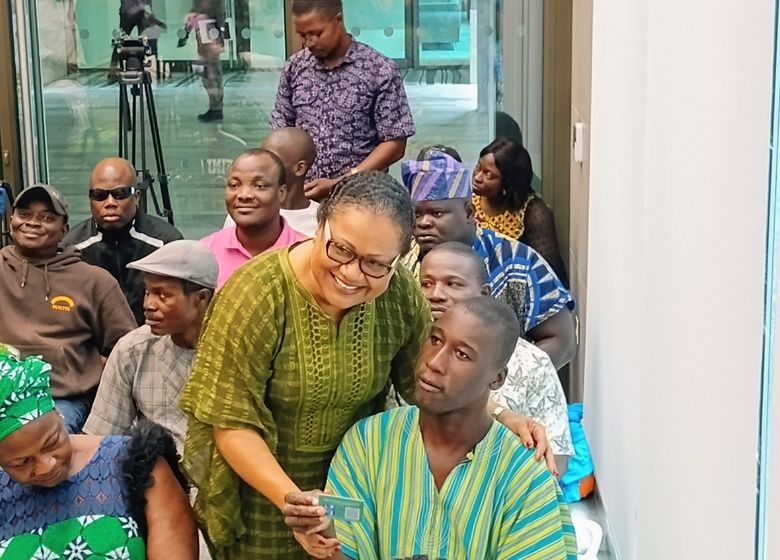
What can a single document genuinely change in someone’s life? That question sits at the centre of Benin’s latest move on social inclusion, after 1,422 new chance equality cards were formally handed over to people living with disabilities. The transfer lifts the total number of cards produced by the national identification agency above the 6,100 mark, with the ministry of social affairs now tasked with rolling them out step by step nationwide.
A handover that raises expectations
Social affairs and microfinance minister Véronique Tognifodé led the official ceremony where the new batch was delivered. For the government, the moment is another milestone in a policy built around fairness and social protection. But the real test starts now: the cards are printed, the legal framework is in place, and the open question is how quickly they translate into tangible relief for holders and the households supporting them.
What the chance equality card gives its holder
Introduced through the law protecting and promoting the rights of persons with disabilities in Benin, the document is anything but a routine administrative ID. It works as a legal and social tool designed to secure priority, preferential access to a range of essential services.
Health care: lower bills, free equipment
Holders benefit from preferential pricing, along with free access to certain treatments and orthopaedic devices provided in public health facilities.
Education: reduced fees, grants and training
School and university fees in public institutions are waived or trimmed, and card holders move to the front of the queue for study grants and vocational training programmes.
Transport and employment: opening doors
Easier use of public transport comes alongside measures meant to encourage socio-professional integration in both the public and private sectors.
How a card is verified before it is issued
Issuance rests on strict traceability, managed jointly with the national identification agency and the network of one-stop social protection centres operating in the communes. Every applicant first goes through a medical assessment conducted by doctors approved by the state, which formally establishes the degree of incapacity and the nature of the disability before a card is produced.
Beneficiary groups call on families to claim their rights
Speaking for those concerned, the Federation of Associations of Persons with Disabilities of Benin welcomed the continuity of the programme and pressed families and entitled individuals to begin the paperwork at the one-stop social protection centres so that their rights can actually be exercised.
Distribution continues across twelve departments
The identification agency and the ministry of social affairs are keeping up distribution operations in all twelve departments of the country, aiming to reach the thousands of files that are still being processed.
The stakes: rights on paper, rights in daily life
During the ceremony, the minister framed the initiative as part of a wider ambition: turning vulnerable citizens into genuine “privileged of the Republic” and dismantling the barriers of stigma and economic exclusion. The dilemma now facing the programme is a familiar one — a card only delivers when its holder can reach the service counter, the clinic or the classroom. Whether these 1,422 new documents close that gap, or simply mark another step towards it, will depend on how fast the remaining files are cleared and how smoothly the entitlements are honoured on the ground.