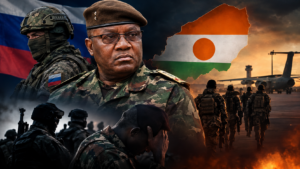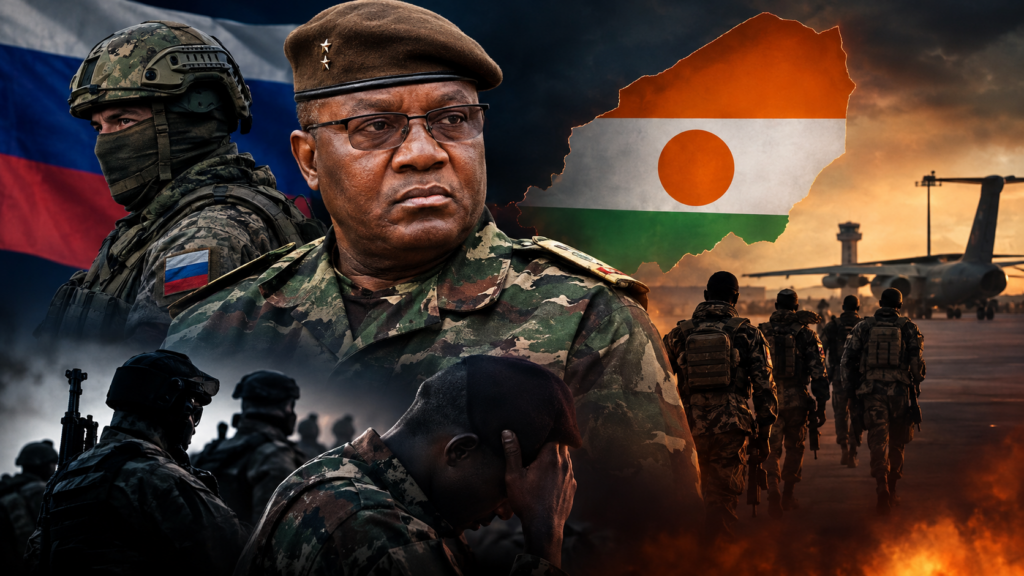
How far was Niger’s ruling military prepared to go to force its own soldiers back into line? That is the question hanging over Niamey after the events of the night of 28 to 29 August 2026 an episode that remains one of the most opaque of Abdourahamane Tiani’s tenure. Soldiers, most of them young men drawn from the special forces, turned against their command. Base 101 at Diori-Hamani international airport, several sensitive installations and the perimeter of the presidential palace were targeted. For nearly twenty-four hours, the military leadership lost control of the situation.
The most telling detail of that night lies elsewhere. It was Russian fighters attached to the Africa Corps who played a decisive part in retaking the air base, providing ground and air support to the units that had stayed loyal to Tiani.
But behind that foreign intervention sits a far more uncomfortable question: Tiani is said to have ordered the elimination of the special forces a decision that led to the arrest and dismissal of the former chief of staff, Moussa Salaou Barmou, who opposed it and refused what he described as sheer barbarity against his own men.
A mutiny that tipped over into a purge
Once the shooting stopped, the arrests began.
More than 500 soldiers were taken into custody, the overwhelming majority of them from the special forces. Other servicemen are said to have vanished or left the country altogether.
Then came the sweeping reshuffle of the chain of command.
The fall of Moussa Salaou Barmou
On 11 September, Moussa Salaou Barmou, chief of staff of the armed forces and a former commander of the special forces, was removed from his post and replaced by General Mamane Sani Kiaou. A few days later, Barmou was placed under surveillance, reportedly confined to his residence.
Officially, the regime points to ‘dysfunctions’ in the chain of command during the mutiny. That explanation leaves a very large grey area.
Barmou was no ordinary officer. He knew the special forces from the inside he had once led them. And his refusal to endorse a foreign-backed operation against Nigerien soldiers during the crisis of 29 August is said to have deepened the suspicion surrounding him.
Why the Russian role reshapes the balance of power
This is where the affair becomes especially sensitive.
Since 2023, Tiani has steered Niger’s security policy firmly towards Moscow after breaking with several Western partners. At the very moment his grip on power was directly threatened, the Russian Africa Corps found itself at the heart of the counter-operation.
The symbolism is striking: Nigerien soldiers rising up against their own command, and a regime calling on foreign fighters to restore order.
The Russian contingent took part in the operations to retake the air base, and that intervention helped bring the mutiny to an end, with deaths and arrests among the mutineers.
From there, one question forces itself forward: did the Russian intervention merely save Tiani’s position, or did it also redraw the balance of forces inside the Nigerien army itself?
A general who became inconvenient
The case of Moussa Salaou Barmou deserves close attention.
He had taken part in the July 2023 coup and had become one of the key figures of the new regime. Yet his military career and his ties to certain American networks set him apart from the openly pro-Russian turn taken by Tiani.
Once the special forces found themselves at the centre of the mutiny, the chief of staff automatically became a central figure.
Could the leadership still trust him? Could his rivals pin the insubordination of units he had once commanded on him? And above all, what passed between him and the Russian officers during the most critical hours of the crisis?
The answers remain incomplete. One fact, however, is documented: a few days after the crisis, Barmou lost his post.
‘Liquidation’: an accusation that demands proof
Some accounts now frame the events as a deliberate attempt by Tiani to ‘liquidate’ the special forces hostile to the regime.
That is an extremely serious charge.
What is available does establish a heavy crackdown after the mutiny: mass arrests and a far-reaching restructuring of the military hierarchy. It does not, at this stage, publicly establish that a general order to ‘liquidate’ the special forces was ever issued by Tiani.
And that is precisely where real investigative work begins. Who gave the orders during the fighting? Which units opened fire? How many soldiers were killed? How many are still detained, and under what conditions? Which officers were questioned or sidelined? And what exactly was the role of the Russian fighters in the ground and air operations?
The Nigerien authorities have still not provided a complete public answer to any of these questions.
The contradiction at the heart of Tiani’s project
Tiani justified seizing power in 2023 by the need to restore security and put the army back at the centre of national defence.
Three years later, part of the armed forces turned against the leadership. And when the crisis erupted, the regime called in a foreign military partner to retake a strategic installation before carrying out a deep reorganisation of its own military apparatus.
The problem therefore goes well beyond Barmou alone. It touches the very core of the security model Tiani has built.
When a military regime has to lean on foreign forces to contain a mutiny by its own soldiers, and then removes part of its command after the fighting, this is no longer a simple disciplinary crisis. It is the mark of a deep fracture inside the apparatus that holds power.
And behind the official statements, the appointments and the arrests, one question lingers: how much more blood will have to be spilled before the truth about the night of 28 to 29 August finally leaves the barracks?
By Ousmane Tandja — Senior correspondent
By Aïcha Abdou — Senior correspondent