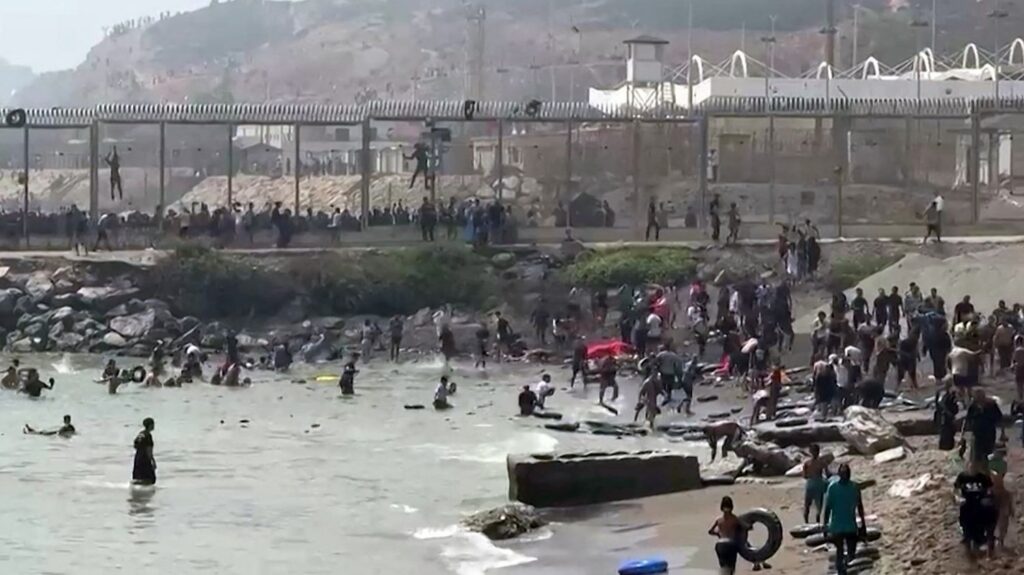
Behind the sudden surge of migrants in Ceuta, Spain suspects Moroccan political pressure
Within just 24 hours, nearly 60,000 migrants illegally crossed into the Spanish enclave of Ceuta, a 20 km² territory bordering Morocco with a population of 85,000. Could this be Rabat’s way of responding to Madrid’s growing ties with Algiers?
Thousands of Moroccan nationals reached Ceuta by swimming just days after Spanish Prime Minister Pedro Sánchez’s visit to Algeria. Back in 2021, nearly 9,000 people crossed into the enclave following Spain’s decision to grant medical treatment to Brahim Ghali, leader of the Polisario Front—a move that infuriated Rabat.
Chaos unfolds at the Ceuta border
The border between Ceuta and Fnideq—Morocco’s adjacent city—descended into chaos as thousands of young Moroccans poured into Spanish territory. This influx represents one of the most severe migration crises in five years. Despite Moroccan police blocking road access, streams of people—including families and individuals with reduced mobility—traversed hills or swam across the sea to reach Ceuta.
Spanish authorities insist that bilateral relations remain strong. Foreign ministry sources described the current agreement with Morocco as “outstanding” and highlighted “intense” coordination to address the crisis. After initial silence, Morocco confirmed the situation and agreed to repatriate those who entered Ceuta illegally.
Legal decision “misused” by human traffickers?
Questions remain about the root causes of this surge. Spain’s Interior Ministry attributes the crisis to human trafficking networks exploiting a recent Supreme Court ruling. The court’s decision guarantees legal assistance and individual case reviews for all those entering Spanish territory. Ruth Ferrero, a political science professor at the Complutense Institute of International Studies (ICEI), clarifies that the ruling does not imply an “open door” policy or prevent repatriations. She emphasized that traffickers likely exploited the legal uncertainty to facilitate illegal entries.
Echoes of the 2021 crisis
This isn’t the first time Morocco has used migration as leverage. In May 2021, nearly 9,000 people entered Ceuta in retaliation for Spain’s decision to hospitalize Brahim Ghali, who was leading the Polisario Front. Morocco condemned the move as “deplorable.” Reports later revealed rumors circulating among sub-Saharan migrants that Moroccan security forces had lifted border controls that day.
Haizam Amirah Fernández, executive director of the Center for Contemporary Arab Studies (CEARC), notes a “pattern” in these mass entries: “Moroccan authorities use human movement as a bargaining chip, often tied to unmet expectations from its leadership.”
Ruth Ferrero urges caution, arguing it’s premature to interpret all migration pressure from Morocco as a deliberate political strategy. “What we’re seeing doesn’t appear to serve a clear Moroccan political goal,” she said. “Instead, the focus should be on how disinformation networks and mafias exploited the situation.”
According to police sources, Moroccan authorities attempted to curb the flow by inspecting public transport and roads, but the sheer volume overwhelmed their efforts, creating a domino effect that overwhelmed border security.
A visit to Algeria that may have triggered tensions
This mass entry occurred just a week after Pedro Sánchez’s visit to Algeria, marking a “new phase” in relations between Spain and the Maghreb nation. During the meeting with Algerian President Abdelmadjid Tebboune and Prime Minister Aymen Benabderrahmane, discussions centered on gas supply—a critical issue amid Middle Eastern conflicts and the Strait of Hormuz blockade.
“The timing is no coincidence,” says Amirah Fernández. “While I can’t confirm a direct link, the rivalry between Morocco and Algeria is at its worst in decades. Sánchez’s visit to Algiers likely didn’t sit well in Rabat.”
He adds that Morocco views Spain’s growing ties with Algeria through a “zero-sum” lens: “If Spain strengthens relations with Algeria, Morocco sees it as detrimental to its interests—and vice versa.”
Ferrero argues that Morocco has gained significant leverage over Madrid, but this stems from a broader European policy of outsourcing migration control to third countries. “It’s not that Morocco sought this position deliberately,” she explains. “Rather, it has skillfully navigated a context where European governments, including Spain, have delegated migration management to external partners.”
The Western Sahara conflict at the heart of tensions
This migration pressure follows years of escalating tensions between Spain and Morocco. In December 2020, Rabat suspended high-level meetings with Madrid after the Trump administration recognized Moroccan sovereignty over Western Sahara in exchange for normalization with Israel. Months later, Spain admitted Brahim Ghali for medical treatment, sparking a deadly border incident in Ceuta.
“The Spain-Morocco relationship is complex,” says Amirah Fernández. “Morocco’s decision-making is centralized, and its approach is often assertive.”
Since gaining independence in 1956, the two nations have clashed over Western Sahara—the former Spanish colony invaded by Morocco in 1975. Spain relinquished control, and today, 80% of the territory is occupied by Morocco, while the remaining 20% is held by the Polisario Front, founded in 1973 as a Sahrawi liberation movement.
Under Trump’s presidency, U.S. recognition of Moroccan sovereignty over Western Sahara in 2020 reignited the conflict, culminating in the 2021 Ceuta crisis. The turning point came in 2022 when Pedro Sánchez wrote to King Mohammed VI, seemingly endorsing Morocco’s autonomy plan for Western Sahara—a departure from Spain’s historical neutral stance. “This letter marked a shift,” says Amirah Fernández. “Spain abandoned its neutral position and sided with Morocco’s proposal, though it stopped short of legally recognizing Moroccan sovereignty.”
The role of social media in fueling the crisis
Beyond political motives, social media played a pivotal role in amplifying the migration surge. A recent study by the North African Human Rights Observatory found that 81% of young people surveyed in Tangier, Tetouan, and Al Hoceima regions viewed social media content portraying irregular migration as a pathway to a better life.
The study, which surveyed 500 young people, revealed that 78.4% found it easy to access posts promoting irregular migration, while 74.2% followed pages offering travel planning and logistical support.