Mayo-Tsanaga crisis: how Boko Haram’s terror is emptying villages
The Mayo-Tsanaga region in Cameroon is under siege. Over 50 villages deserted, thousands displaced, and a government that turns a blind eye.
Boko Haram’s terrorism is no longer a distant threat—it has taken root in the Mayo-Tsanaga department. Originating in Nigeria’s Borno State in the early 2000s, the insurgency crossed borders in 2014, with the first Cameroonian attack striking the village of Tourou, near Mokolo, on the slopes of Mount Gossi.
Since then, the jihadist group has entrenched itself in the region, escalating attacks year after year. Villages burn, lives are lost, and survivors face a relentless cycle of violence. Fields, markets, schools, and healthcare centers are targeted. As the years pass, the human toll grows, and the land lies abandoned. Nearly 13 years after the first strikes, the crisis persists—with no lasting solutions in sight.
From Mokolo to Koza and Mayo-Moskota, the story is one of unprecedented territorial abandonment. More than 50 villages in Mayo-Tsanaga have been fully or partially deserted. Among them: Gossi, Tourou, Vizik, Ldamang, Magoumaz, Ldubam, Dinglding, Chougoulé, Oupai, Houdahai, Vouzoud, Ldama, Ziver Montagne, Houva, Gouzda Wayam, Tchébé-Tchébé, Koza, Locktcha, Toufou, Guedjele-Guibedrom, Zelevet, Krawa-Mafa, Ldaoutsaf, Merekouet, Dzamadzaf, Hitéré, Bavangola, Vreket, and Gouzou-dou.
In May 2022, the fifth deputy mayor of Mokolo, Mahadek Nicolo Nouhou, presented a grim assessment to the Minister of Public Health, Manaouda Malachie, during the fraternal meetings in Tourou and Mokolo: ten villages completely deserted, two under Boko Haram control, and seven others frequently attacked. Terrorists now operate almost permanently in Gossi, Toufou 1, Toufou 2, Roum, and Hitawa, forcing residents to flee.
Since then, conditions have worsened. Residents of Tourou voice their despair: “We feel abandoned, as if we no longer matter to our leaders. Are we not Cameroonian citizens?”
For over a decade, fear has dictated life in Mayo-Tsanaga. By night, men flee to the mountains, sharing caves with wildlife to escape the danger. Come dawn, they return to work. The state’s response? A handful of soldiers scattered across the region. During the June 18, 2026 attack on Ldamang and Ldubam, only two soldiers were present—hardly a match for heavily armed insurgents. Civilian vigilante groups, armed with machetes, are left to fend off assault rifles.
Local elites remain conspicuously silent—a complicity by choice. While they make promises at election rallies, their actions betray the people. Ministers have visited, held meetings, and made declarations. Then silence. The attacks continue unabated.
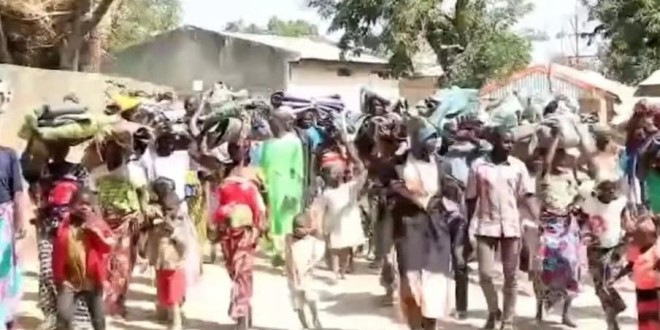
Over 9,000 people displaced by Boko Haram’s violence still cannot return home, and the number keeps rising. In early June 2026 alone, the International Organization for Migration recorded 482 new displaced individuals—78 households—fleeing attacks in Mokolo, Koza, and Mayo-Moskota. The crisis has spread beyond Mayo-Tsanaga: by July 2026, a local official in Kalfou, Mayo-Danay, reported welcoming nearly 300 displaced people from Mokolo, some 210 kilometers away. Families abandon everything—homes, land, livelihoods—in a desperate search for safety.
Those who flee also leave behind their identities: birth certificates and national IDs reduced to ashes. But the deepest tragedy is the separation of families. In the chaos of attacks, parents and children are torn apart, some left behind in the panic. Children and adolescents, now on their own, face a bleak future. Many drop out of school, some turn to crime, and young girls lose hope of a better life.
The Mayo-Tsanaga is being emptied. Farming collapses. Schools close. The local economy vanishes. Without urgent action, the region faces irreversible depopulation. The state cannot afford to ignore its citizens simply because they live far from Yaoundé. How many more villages must be abandoned before this crisis becomes a national priority?