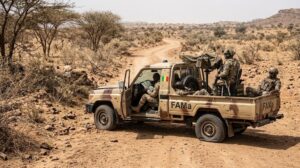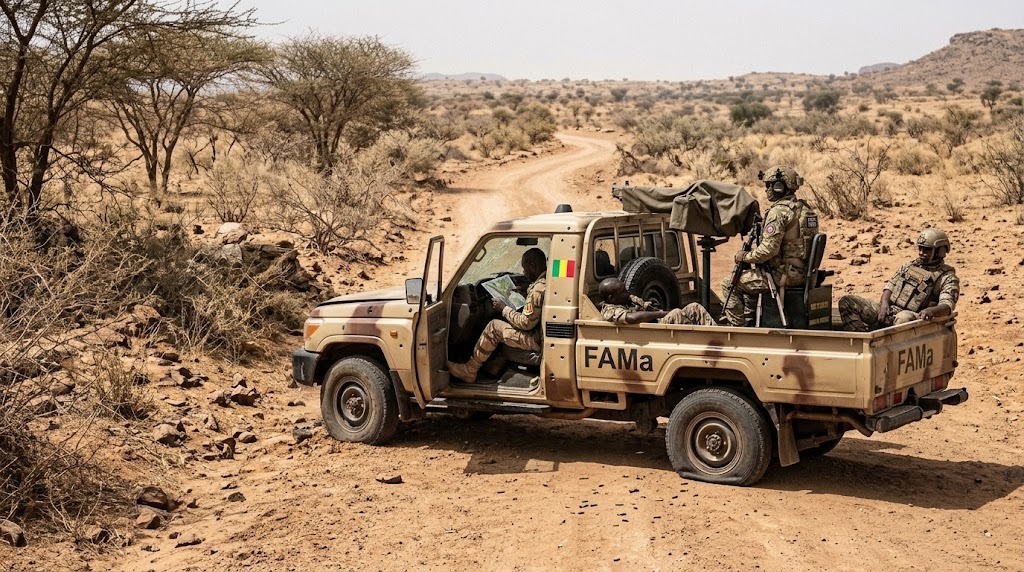
At Molodo, along a dust-choked track between Diabali and Niono, a question Bamako has dodged for four years was settled in a matter of minutes. On 20 September 2026, a joint patrol of Malian armed forces (FAMa) and Russian Africa Corps paramilitaries collapsed under fire from an ambush laid by the Group for the Support of Islam and Muslims (JNIM, an Al-Qaeda affiliate). The ambush unfolded in the Ségou region, an area the central government presents as firmly under its control.
The men sent from Moscow reverted to familiar reflexes: a hurried withdrawal, and three all-terrain vehicles left standing on the roadside, exposed to the cameras of the attackers. Each bore the stylised triangle of Africa Corps, the Wagner successor now placed under the direct authority of Russia’s defence ministry. The tactical loss matters. The strategic question matters far more — what has Mali actually bought, and what becomes of the junta if the answer is nothing?
What the Molodo firefight reveals about the Russian deployment
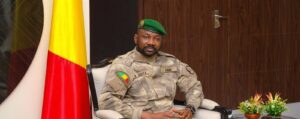
For Colonel Assimi Goïta’s government, this is not simply another setback in an attrition war it does not control. It works as a magnifying mirror on a political and security failure whose scale can no longer be disputed.
Since pushing French Barkhane forces out, driving the UN mission (MINUSMA) towards the exit and tearing up the peace agreements, the military leadership has built its entire legitimacy on one central promise: the recovery of “national sovereignty” and the full securing of the territory through geopolitical rupture. To persuade a population worn down by more than a decade of instability, Bamako sold Russian diplomacy as the miracle cure, insisting that Moscow’s “instructors” would achieve what Western allies had neither the will nor the capacity to deliver.
Four years after the first mercenaries arrived on Malian soil, the verdict is blunt: the Russian partnership is a toxic illusion, and it is paid for at a very high price. Far from erasing the jihadist threat, the arrival of the Russian militia has acted as a powerful recruiting engine for armed opposition and Islamist groups.
Why insecurity has turned into a way of governing
State propaganda can no longer smother the facts. Despite triumphant statements drafted from the air-conditioned offices of the general staff in Bamako, Mali has rarely been in worse shape. Insecurity, once confined to the desert fringes of the north, has spread through the centre of the country and now encircles the capital through economic strangulation, road blockades and attacks on garrisons.
The Molodo ambush lays bare a brutal military reality: Africa Corps mercenaries are neither invincible nor devoted to the cause of the Malian people. Paid handsomely by an exhausted state that draws on thin public resources and hands mining concessions to companies linked to the Kremlin, these private soldiers operate as a close-protection force for the regime rather than as a liberation army. In the field, against a mobile enemy perfectly acclimatised to the terrain, blind brutality has replaced tactical strategy. Joint FAMa-Russian operations, shadowed by repeated accusations of abuses and extrajudicial killings against civilians, have finished severing the army from rural communities.
A bunkered regime that outsources its own defence
By delegating the defence of their own territory to mercenary contractors who run the moment a trap closes, the junta’s officers reveal the true nature of their power: a survival regime, bunkered in Bamako, more focused on holding on to office than on protecting the nation.
- Territorial control handed to a foreign militia that retreats under fire.
- Public money and mining concessions diverted to fund that militia.
- Rural populations bearing the cost of operations they never consented to.
Silencing doubt while the images travel
To muzzle dissent in the face of this unrelenting security and economic decline, the junta has deployed an unprecedented repressive arsenal. Critical voices from civil society are silenced, the independent press is censored or hounded, and the slightest doubt expressed about the effectiveness of the “Russian partner” is immediately branded high treason or collusion with the enemy.
But propaganda offers no protection against the ground truth. Images of the three vehicles bearing the Africa Corps logo, deserted by their Russian crews on the Molodo road, are already circulating quietly and across social media. They confirm what many Malians now whisper in the shadows: under the cover of fighting neo-colonialism, the military leadership has traded an imperfect dependency for a ruinous subordination to a private militia incapable of guaranteeing peace.
The dilemma Bamako keeps postponing
By persisting in this ideological and military flight forward, Mali’s rulers have locked the country into a tragic dead end. Without an overarching political strategy, without national reconciliation, and with foreign troops who flee at the first shot, the Malian state continues to crumble, leaving a wounded people in the hands of extremists and war profiteers.