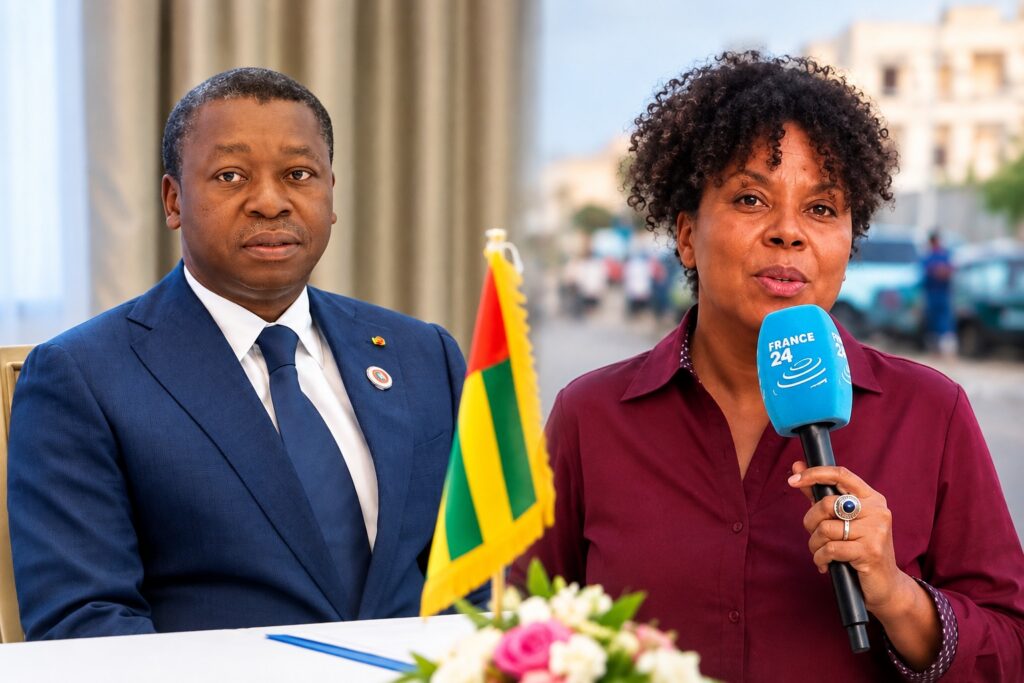
In Togo, the line between responsible journalism and state control has never been so sharply drawn. The latest controversy surrounding journalist Emmanuelle Sodji raises a critical question: when public information circulates widely, can the state retroactively punish journalists for reporting it before official restrictions are announced?
The case, which has drawn international attention, underscores a broader struggle over press freedom in a country led by President Faure Gnassingbé for nearly two decades. It forces observers to ask: how much leeway should authorities have to restrict information, and what safeguards must exist to prevent abuse?
From incident to institutional test: the Sodji case
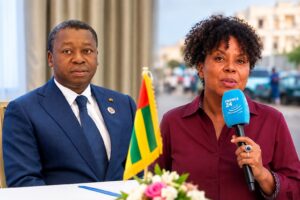
The controversy began on August 18, 2026, when Emmanuelle Sodji, a veteran correspondent for France 24 based in Benin, published details about the legal troubles of two French nationals detained in Togo. The men, documentary filmmakers Gaël Mocaër and Sebastián Pérez Pezzani, had been arrested on July 27 in northern Togo while working on a project and faced charges related to visa irregularities. They were freed on September 1 and allowed to leave the country.
According to the National Union of Journalists (CGT), the information Sodji relayed was already publicly available across multiple outlets and social media platforms. More critically, Togo’s media regulator acknowledged the following day that the same details had been circulating since August 18. The union now argues that Sodji’s subsequent removal from her position raises serious concerns about retroactive enforcement and press freedom.
The regulator’s acceptance that the facts were in the public domain complicates the justification for penalizing a journalist who simply reported what was already known. This ambiguity lies at the heart of the dispute and has reignited debates over regulatory clarity and editorial responsibility.
Regulation or restriction? The evolving landscape of Togo’s media
The controversy over Sodji’s case is not isolated. It follows a June 2025 decision by Togo’s High Authority for Broadcasting and Communication (HAAC) to suspend broadcasts of RFI and France 24 for three months, citing alleged inaccuracies and biased reporting in certain programs. The media outlets rejected these claims, but the episode deepened concerns about shrinking media space in a politically tense environment.
Togo has witnessed growing public protests against the government, notably in Lomé, where demonstrations in mid-2025 were met with heavy security responses. These events have only heightened scrutiny of any measures that might curb press freedom or silence critical voices.
In such a climate, every regulatory decision involving the media is examined closely. It is no longer just about compliance—it is about whether enforcement mechanisms are being used to control narratives rather than protect public interest.
Defining the boundaries: rules, timing, and transparency
The fundamental dilemma is not whether journalists must follow professional rules. They must. The question is what those rules are, when they become applicable, and how they are applied. In a functioning democracy, restrictions on sensitive information—especially during legal proceedings or national security concerns—are expected. But such limitations must be clearly defined, publicly known in advance, and applied consistently and transparently.
Conversely, journalists bear the responsibility of verifying sources, respecting legal processes, and avoiding speculative reporting. However, when information circulates broadly in multiple channels and is later validated by regulators themselves, the grounds for punitive action become harder to justify.
Sodji’s case has exposed a dangerous gray area: can authorities retroactively impose sanctions for actions taken under what was perceived as free information flow? The absence of clear, published guidelines prior to enforcement raises concerns about selective or politically motivated interpretations of the rules.
Beyond one correspondent: a watershed for Togo’s democratic space
This dispute transcends the fate of Emmanuelle Sodji. It touches on the very core of Togo’s democratic health. Under President Gnassingbé, the country has seen institutional reforms and persistent political tensions. Each restriction on the media now carries symbolic weight—it signals whether the government is committed to fostering an environment where journalists can investigate and report freely, or if it seeks to control the narrative through punitive measures.
Press freedom is not about immunity from rules. It is about operating under transparent, predictable guidelines that protect the public’s right to know without fear of arbitrary retaliation. When a journalist reports on information that is already public and verified by official bodies, the burden of proof shifts to the regulator to demonstrate why a sanction was necessary—and when the rules were actually in force.
Togo now stands at a crossroads. The international community and local observers alike are watching closely. Will the government clarify its regulatory framework? Will it provide journalists with the legal and institutional guarantees needed to operate without undue interference? Or will the pattern of restrictions continue, further eroding trust in the country’s democratic institutions?
One thing is clear: the answers will define not only the future of journalism in Togo, but the strength of its democracy for years to come.